

 |
|
|
Press Releases: |
Essays: |
Introductory and Welcome Letter
Our goal is to create the most open process ever seen in Colorado and the United States when it comes to a proposed development. Rather than shun the spotlight of public scrutiny, we welcome it. We want every citizen in and around Erie - as well as others willing to critique our work - to examine what we are doing and give us their thoughts and ideas on how we can improve this project.
This is why we decided to put our entire effort on the World Wide Web. In this manner, citizens can view what we are doing at their convenience. They do not need to go to Town Hall and look up materials. They do not have to pay for copies of documents but can download them directly from our site for their own personal review. (Please note that all materials on this site are copyrighted and owned by Golden Run, LLC. They are for use by the citizens of the Town of Erie in their evaluation and participation related to the project and may not be used by any entity for any other purpose without the prior written consent of Golden Run, LLC.)
We want your involvement and participation. We seek your help and endorsement. We want you to contact us and tell us what you think and how we can do better.
Golden Run is being created to show Erie and the rest of Colorado that there is a new model available for Smart Growth. For those who want to manage growth and slow its pace so that communities can have the time to absorb and adjust to growth, Golden Run makes sense. Rather than build as many houses as fast as possible, sell them all, and move on to the next development, Golden Run is being designed as a project which will grow slowly. This gives it time to make necessary adjustments and to create a community as well as better fit into the broader Erie community.
Our goal is to create a place to live and work where there is less dependence on automobile transportation. We want to create connections between people and places. The idea is to create an environment where people are connected to the land and to each other. Where the environment truly is sustainable. Where community gardens, recycling, composting, gray water systems, and solar siting all are encouraged and flourish.
We want to create opportunities for people to live near their work, to promote telecommuting, and make it easy to start and cultivate a business. Making neighborhoods which are "walkable" is a critical component of what we are trying to do. Using smaller lots so more land remains undeveloped and the entire area can enjoy larger and more open green spaces is a critical objective. Expanding the wildlife habitat we created and nourishing it, for everyone's enjoyment, is an example of what we hope to accomplish.
By setting such extraordinary goals and high standards, we also hope to have another impact. That is the effect we expect to have on development elsewhere in Erie and throughout Colorado. If we are successful, Erie and other municipalities will start demanding more of developers and builders. They will "raise the bar" and start requiring developers and builders to think more about creating "communities" and not just developments. They will demand developers and builders invest more in their communities and create projects which are environmentally sound and sustainable. They will require that developments be designed so they truly are part of the existing community and not be the stand-alone, independent entities we so often see. With "Golden Run" setting the pace, Erie and other towns can and will ask for more - as they should.
Will this be easy? No. But together, as a community, we can do this. Will it take longer than the time it takes an assembly-line developer and builder to simply put up house after house? Yes. Will it be more expensive to do? Yes. But will in be worth it when we look back 25 years from now and see what we created? Absolutely. Good things take time and may cost a little more but, in the end, we all will be glad we did it.
Thanks for your willingness to participate in this project. Please contact us and give us your opinions. We want your input and involvement. We know you care about your community. And we hope you will endorse our effort.
Sincerely yours,
Aaron Harber
|
Press Release
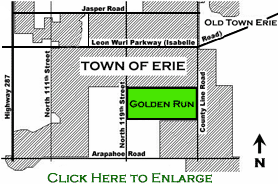
01- 22 March 2000 BOULDER COUNTY'S FIRST LARGE-SCALE "GREEN" COMMUNITY PROPOSED FOR ERIE PROJECT COMBINES "SMART GROWTH," "NEW URBANISM" AND "HEALTHY COMMUNITIES" NEW APPROACH SEEKS TO SET HIGHER DEVELOPMENT STANDARDS IN BOULDER COUNTY 'GOLDEN RUN" TARGETS SENIORS, ENVIRONMENTAL, HIGH-TECHNOLOGY CAMPUS GOALS NEW STANDARD OF COMMUNITY INVOLVEMENT AND OPENNESS TO BE ANNOUNCED Erie, CO - Using a combination of elements from "Smart Growth," "New Urbanism," and "Healthy Communities" strategies, a new community is being proposed for Erie on a parcel of land long-surrounded by the Town and slated for development years ago. The property, known as "Golden Run," was to be zoned "Primary Urban Density" development - Erie's highest density residential designation - for over two decades and is located within one mile of "Old Town" Erie. The organization submitting the plan, which proposes Boulder County's first large-scale master-planned "green" development effort, is Golden Run, LLC. "Our goal is to help set new standards for growth in Erie and across the Front Range," explained Golden Run General Manager Carl Oldham. "We want to do this differently. Rather than simply allowing developers to put up homogeneous housing as quickly as possible, we want to demonstrate that communities can ask for more. Our emphasis is on creating 'connections' within the new neighborhoods we are creating and linking Golden Run with the rest of the Town. We are taking the time, working with the Town staff, neighbors, and citizens across the area, to create a plan which keeps people connected with the land and with each other. We want to create a place to live which is people-friendly and environmentally-sustainable - where people are not so dependent on the automobile, and where folks can walk to where they work, shop, play, and go to school." "By using the best 'New Urbanism' has to offer," explained Ed Byrne, an attorney who specializes in planning, we can create neighborhoods where people can more easily get to know each other - neighborhoods which make even more sense when examined in their regional and community context." New Urbanism is known for clustering buildings, using smaller footprints, building homes with front porches, and a host of other techniques - many taken from construction designs used at the turn of the century - which promote interaction and relationships while minimizing the impact on the land. "This plan will employ a wide variety of designs, colors, and structures. When completed, Golden Run will have the look and feel of Boulder County's 'Old Town' neighborhoods and commercial areas. Our finest communities evolved for decades at a time when resources were scarce and people depended on one another to survive. Form followed function then, and it will again in Golden Run." Byrne revealed that there was a special emphasis on the needs of seniors citizens throughout the project. "Our mature citizens have a broad range of needs which are not being met in Boulder and Weld Counties' housing markets. The project is aptly named 'Golden Run' because it is designed to enable different generations of families to live closer together. We expect to have housing which meets the full range of the needs of mature citizens. This will include 'empty-nester' homes, apartments, independent living units, assisted living residences, long-term care homes, and high-level care facilities. Our goal is to create a community where those with the most wisdom do not have to move out and where our youth can find places to move in to stay." "Most importantly, what this plan does," elaborated architect Fenno Hoffman," is to use urban design tools and ecological and social sensitivity to create something more complicated and interesting than the bland 'zones' and spaghetti streets everyone finds so oppressive and confusing. Golden Run will house a healthy mix of activities in a variety of styles and scales of both architecture and open space. Neighborhoods will share public parks and wildlife habitats. Avenues, streets, and paths have a hierarchy and geometry which uses landmarks such as pocket parks and fountains to visually and socially connect everything. Street grids will encourage walking and calm traffic, while echoing the layout historical towns throughout Colorado -- with an emphasis on Old Town Erie. The edges of the project are designed not to exclude or shut-out but to connect and be part of Erie. The neighborhoods within Golden Run are similar. Live/Work studios, townhomes, and apartments over shops create affordable options for those not needing or wanting the traditional single family home. Young singles and grandparents can be down the street in a lively part of Town, instead of being isolated and alone, far away. All of this will be done on a walkable scale so it is only a five- or ten-minute walk to get some sugar, visit and uncle or friend, get some coffee or even go to work." Hoffman disclosed that while a typical 320-acre development might have 20 or 30 acres of open space and similarly "green" areas, the Golden Run proposal had almost 140 acres of such spaces. "Our design shows that it is possible to create and preserve green spaces, maintain view corridors, and minimize traffic while providing a rich social experience and architectural variety in a plan which gives something back to the community that surrounds it.." Fenno said the group expects strong community support for the design because of the high standards it sets and the diversity it offers. "We believe people in the Erie area want a new model for development and that this is it." Oldham noted, "With the New Urbanism approach, we will use mixed sizes of lots with a variety of different high quality building standards and creative options so people still have very attractive life-style opportunities. By using an approach which mixes small parks and small commercial operations throughout residential areas, people can work, shop, and play near their homes. By creating communities which are 'walkable,' people can stay connected to the land. To do this means avoiding the tendency of developers to build on and pave every inch of a project." The effort also has a key high-tech component with the entire community expected to be "wired" to promote use of the Internet and future technologies throughout homes, schools, other public buildings and all commercial buildings anticipated to be on the property. "Our goal is to create a community where everyone is linked and where telecommuting is easy and where everyone has access to all the information they need at all times," observed Jeff Ruppert, a leading-edge proponent of alternative construction designs and the key engineer for the project. Ruppert also noted that the project provides sufficient commercial space - including office space - to create a business campus as a possibility. "A far-sighted company will see Golden Run as an opportunity to locate its operations where it not only has sufficient commercial facilities but where its employees have the opportunity to live and play within walking distance of work. These are the kind of new opportunities we are trying to create." Ruppert commented, "Our goals of sustainability - environmentally, economically, and socially - are being met through a number of diverse ways. We are using an incremental approach that will add up to a considerably more efficient, healthier community at all levels. Our goals will be to have a 'zero sum' impact on the surrounding community physically, while enhancing connectedness among neighbors." Ruppert also mentioned environmental responsiveness, resource efficiency, community and cultural sensitivity, and the integration of ecology with real estate as being the key elements of "Green Development." "We have been approached by developers for years," long-time environmentalist and property owner Aaron Harber disclosed. "We decided the best way to be sure this project proceeded with the needs of the entire community in mind was to try and do it ourselves. It is taking us longer and is more expensive but, in the end, we know we will have done the right thing." Harber is a 31-year resident of Boulder County. He has lived in the Erie area for over a decade. The land known as Golden Run is where he lives with his daughter Holly. "We differ from developers and builders because we are a permanent part of the community," Harber asserted. "We have watched growth skyrocket in the area and have realized this is one way we can help shape that growth. We can show citizens that it is OK to demand more of developers and builders - that we need to hold them to higher standards. What this project will prove is that you can ask for more and everyone still comes out ahead. Unlike most developers, we live on the property and are here to stay. We want to influence what will be around us for decades to come. Golden Run offers us and everyone in Erie that opportunity." As part of the project, Mr. Harber expects to donate significant acreage to the Town to use for parks, open space, and other civic purposes - possibly including a school, a performing arts center, a library or a recreational site. "We are particularly enthusiastic about the idea of expanding the Wildlife Habitat we started eleven years ago as well as creating walkable links to surrounding communities - especially Old Town Erie," Harber said. The Wildlife Habitat includes a six-acre pond and the Harbers hope eventually to see the Habitat area doubled in the future. Harber emphasized other elements which excited him. "From its initial design, we want this project to incorporate elements such as community recycling, solar siting, community composting, efficient utility usage, community gardens, and gray water systems. We see the high-tech broadband hard-wiring element as being environmentally-friendly. It's a way to reduce everyone's reliance on cars. And by staying involved with and spending our time and money on the project, we are able to make certain all these goals are achieve," he continued. "The other aspect of our approach which is radical in nature is how we are involving everyone in the process from the beginning," he said. Harber disclosed that the Golden Run Team held numerous meetings to develop the plan and has met with neighbors, Town staff, prospective partners, and citizens of the Town and in unincorporated areas around Erie before even submitting its plan. "We are looking at an extraordinary level of openness to this project and are preparing a plan to implement this objective," he concluded. Golden Run expects to have a major announcement next week which will set new standards for citizen involvement, communication, and trust. Golden Run is located one-half mile north of Arapahoe Road and one-half mile south of Leon Wurl Parkway (formerly Isabelle Road). Its western border is North 119th Street and its eastern border is County Line Road. The property lies completely in Boulder County and was assigned to Erie for development by the multi-party Intergovernmental Agreement of 1994 between Boulder County, the City of Lafayette, and the Town of Erie. |
|
|
ERIE "SMART GROWTH" PROJECT ANNOUNCES EARLY MEETINGS ENVIRONMENTALLY-SENSITIVE PROJECT OFFERS EARLY CITIZEN INVOLVEMENT PUBLIC INVITED TO PARTICIPATE IN URBAN VILLAGE PLANNING Erie, CO - Just days after announcing a "Smart Growth" plan for a group of environmentally-sensitive, Urban Villages to be created in Erie, Colorado -- collectively known as "Golden Run"-- project leaders announced they would sponsor four Public Meetings to present "Smart Growth," "New Urbanism," and similar leading-edge concepts being applied to Golden Run and to give the public its first look at the project's conceptual plan. "By getting people involved right at the start of the process, we can shape this project to meet the needs and desires of the community," asserted Carl Oldham, the General Manager of Golden Run. "While this requires more time and effort initially, we think involving the public early is a good model for all future developments." Oldham disclosed he was unaware of any project in the area which held public meetings at the same time it was submitting its original application. "Our early approach means that citizens will have a chance to review our ideas and plans as well as comment on them before we even receive any formal feedback from the Town of Erie," Oldham noted. "This puts citizens on equal footing so decisions cannot be made before the public has a chance to really become involved. We believe this is what citizens want." The Golden Run team believes this is the first project in Erie which has offered Public Meetings prior to formal consideration. "This is the new standard we are using this project to set," offered Aaron Harber, Denver PBS Talk Show host and the owner of Golden Run. "We want to show municipalities, property owners, builders, and developers that they can and should trust the judgment of citizens and that it makes sense to involve people early in the process. Our goal is to create the most open and accessible process possible and to get everyone to adopt this perspective as the new standard." The meetings will include a presentation on "Smart Growth," "New Urbanism," and similar land use concepts as they apply to the area and to the Town of Erie in particular. The conceptual plan for Golden Run also will be presented. Ample opportunity for participation will be structured into the sessions using a "Question & Answer" format. All meetings are open to the public. The first presentation of "Smart Growth Concepts" and the Conceptual Plan for Golden Run -- a project designed to set new and higher standards for development in Erie - will be held on Monday, April 24th, from 7:00 pm until 8:00 pm at the Arapahoe Ridge Community Center, 1750 Powell Street in Erie. The second Public Meeting to review and discuss the Golden Run proposal will be held on Wednesday, April 26th from 7:00 pm until 8:00 pm in the Board Meeting Room on the lower level of Erie Town Hall. Town Hall is located at 645 Holbrook Street in downtown Erie, Colorado. The third Public Meeting is scheduled for Monday, May 1st, from 7:00 pm until 8:00 pm at the Arapahoe Ridge Community Center, 1750 Powell Street in Erie. A fourth Public Meeting is scheduled for Tuesday, May 2nd, at the home of Aaron and Doreen Harber, 2500 North 119th Street, from 6:30 pm to 7:30 pm. Due to space limitations at this private home location, attendees must RSVP no later than Friday, April 28th, to Carl Oldham of Golden Run by phone at (303) 497-0610 or via e-mail at Carl@GoldenRun.Com. For further information or directions, please contact Ed Byrne at (303) 478-8075 (Ed@GoldenRun.com) or Carl Oldham at (303) 497-0610 (Carl@GoldenRun.Com). The public is strongly encouraged to attend and to participate in this effort to raise the standards for development everywhere. |
|
|
PROJECT SPONSORS CREATE NEW LOCAL AND NATIONAL STANDARD FOR PUBLIC ACCESS ERIE LEADING-EDGE "SMART GROWTH" PROJECT GOES ON-LINE ULTIMATE EASE-OF-USE FOR CITIZENS EXAMINING ENVIRONMENTALLY-SENSITIVE PROJECT 'WWW.GOLDENRUN.COM" COULD BE FIRST OF ITS KIND IN THE NATION Erie, CO - In what might be a nationally-trendsetting move, the sponsors of an environmentally-sensitive set of Urban Villages to be created in Erie, Colorado -- collectively known as "Golden Run"-- announced that their entire application to the Town of Erie and all related materials were being made available to the public, on-line, at no charge, on a 24-hour-a-day, seven-days-a-week basis via the World Wide Web. "Our goal is to have the most open process ever seen for a project of this magnitude," former software company president and current Denver PBS Talk Show public affairs host Aaron Harber revealed. "We want to set a new standard so developers and builders across the country will be required to submit their plans for true public inspection before a single issue is decided or before any commitments are made." Harber acknowledged that such an approach contradicted traditional strategies in which some developers and builders did not encourage and actually often avoided public scrutiny for as long as they could -- especially at early stages in a project's development when citizen involvement was most critical and could derail a project. "What is unprecedented is the combination of (1) a completely accessible site with (2) this volume of material and (3) the timing of its availability," stated Carl Oldham, the General Manager of Golden Run. The Web site's official opening date was 21 April 2000 -- well before the project received any formal feedback from the Town of Erie, which is responsible for the approval of Golden Run. According to the Web site designer, Zac Adler, the principal of Intrinity Studios, LLC in Boulder, Colorado, revealed the Golden Run site ultimately is projected to contain more than 10 million bytes of information -- the equivalent of over 2,000 pages of text documentation. Adler explained, "We already have the equivalent of about 500 pages of text, representing just 25% of the site's content. The majority of the site --75% --is in the form of graphical images." The Web site offers maps, drawings, conceptual plans, charts, tables, figures, and everything in Golden Run's complete, formal submission to Erie. "My instructions were to include everything, so that's what we did," Adler disclosed. He also revealed that the effort had taken over two months to complete. "To have citizens and Town officials looking at a project at the same time is unheard of," Oldham asserted. "This gives everyone a chance to participate in the process right from the start. This is the standard we hope to help set in Erie, in Colorado, and across the nation. Too many decisions are made by governments before the people most affected get a chance to be involved. With our Web site, we can invite the entire Erie area community to participate at their convenience and at no cost to themselves in the design and approval process before there is a single hearing on our proposal. That's the way it should be." Ed Byrne, an attorney who specializes in land planning and who is a member of the Golden Run team elaborated, "Our goal is to create the most open process ever seen in Colorado and the United States when it comes to a proposed development. Rather than shun the spotlight of public scrutiny, we welcome it. We want every citizen in and around Erie - as well as any others willing to critique our work - to examine what we are doing and give us their thoughts and ideas on how we can improve this project. And citizens can view what we are doing at their convenience. They do not need to go to Town Hall and get in line to ask for assistance looking up materials. They do not have to pay for copies of documents but can view and download them directly from our site for their own personal review. And it's great for government staff members who won't have to spend their time looking up and photocopying documents. With our 'Open Access' approach, everyone comes out ahead." Harber stated, "This is our way of saying to everyone, 'We want your involvement and participation. We seek your help and endorsement. We want you to contact us and tell us what you think and how we can do better.'" Harber encouraged citizens to view the site and send in their comments about the proposal itself and how Golden Run could improve the Web site as well as the Golden Run team's effort to redefine "Public Access." Harber is known as a long-time advocate of public access and for strongly supporting the Press's and the Public's right-to-know. In 1982, he won a case against the Colorado Secretary of State, which attempted to withhold Public Records in the easiest-to-use format. He was assisted by a then neophyte lawyer who now is Colorado's Attorney General. Over a decade and a half later, he won an Open Records case against the Northern Colorado Water Conservancy District, which attempted to mislabel public information as "confidential." It was a rare victory by a citizen in Colorado. Harber concluded, "By building this Web site ourselves, we can demonstrate how this can be done and why municipalities and government agencies across the country can begin to insist that all submissions subject to public review should be available on the Internet at the earliest time possible. Ultimately, we would expect submissions to actually be made via the Web so government staff would have the same ease-of-access citizens have. This would allow updating to be done quickly and easily, and would save government agencies a lot of time while providing a tremendous convenience to them as well." Anyone with Internet access can view the site by going to "www.GoldenRun.com." All materials on this site are copyrighted and owned by Golden Run, LLC. They are for use by the citizens of the Town of Erie in their evaluation of the project and may not be used by any entity for any other purpose without the prior written consent of Golden Run, LLC. For further information, please contact Ed Byrne at (303) 478-8075 (Ed@GoldenRun.com) or Carl Oldham at (303) 497-0610 (Carl@GoldenRun.com). |
A New Approach
A VISION FOR ERIE - A $232 MILLION GIFT FOR THE TOWN
ERIE AT A CROSSROADS: HAVING GROWTH PAY TO IMPROVE A COMMUNITY
INNOVATIVE CIVIC FEE FUND COULD PROVIDE SPECTACULAR RESULTS
Sometimes it is beneficial to step back and take a look at what's really going on in a community. In the case of the rapid development occurring in Erie, developers and builders are putting up hundreds of homes annually and selling them for tens of millions of dollars. How can the citizens of Erie, through their government, ensure that growth pays for itself and that there are benefits to the entire community from that growth?
Traditionally, growth does not pay for itself. As a town or city grows, it typically requires new levels of services which can cost geometrically more than the services provided to a smaller population. Additional federal and state regulations come into play at higher population levels -- imposing stricter standards for water treatment, waste disposal, et cetera -- and those requirements can result in huge cost increases for a municipality which experiences just modest growth. This can mean a cost of a service might increase 100% while the population only increases 50% - resulting in a higher per capita or per taxpayer tax burden for essentially the same service.
GROWTH CHANGES A COMMUNITY
Similarly, growth changes the nature of a town in both good and bad ways. Having more people can mean a greater variety of people and new opportunities for friends and interaction. It can mean an expansion of the sense of community and having more people available to help each other in times of need. It can mean more business opportunities and service offerings. But growth also can mean more traffic on the roads, more pollution, more crowded schools, and higher crime rates as well as a sense of loss of a "rural feel" which a town such as Erie has had for decades. It also can mean the loss of a sense of community when that sense was based on a resident's ability to know a large percentage of the population. It's easier to know everyone in a town of 1,000 people than 10,000 people, and it's impossible to know everyone in a city of 100,000 people. While none of these negatives are automatic, these issues need to be addressed in advance of growth -- not after it has occurred or else it might be too late.
Growth, if well-planned, can make a positive contribution to a community. One must challenge traditional thinking. For example, a single development might result in a town's water supply or treatment plant or wastewater facilities becoming overburdened. This could result in the need for a multi-million dollar facility simply due to this one additional development. Perhaps, in such cases, it makes sense for some new developments to consider providing some of their own municipal services or having the developer agree to pay the extra cost. Some projects are structured to do this so they can avoid being burdensome to a town, if that option is the best alternative for everyone.
This also is why it is reasonable to have developers and builders pay higher fees to mitigate the impacts of growth. Sure, developers and builders are squawking that Erie has the highest building-related fees in the State of Colorado. But if demand for housing remains high and the current fees do not cover the costs of growth, it is reasonable for the Town to raise those fees even further to cover the true costs of growth and to ensure the new construction makes a contribution to the broader community. Exceptions given to developers and builders who provide low-income or subsidized housing options may make sense but, in most cases, Erie still should charge even more and higher fees.
Erie and other towns across America are justified in asking more of developers and builders and they still will come. As an example, Erie could consider the two largest annexation requests it has had. In one case, 4,500 homes would be built. In another case, 2,500 homes are planned. That would be a total of 7,000 homes. Over the next 30 years, Erie is likely to see a total of 12,000 homes built (an average of 400 homes annually) - bringing its population to about 35,000 people -- the same as Lafayette and Louisville but a third the size of Boulder or Longmont by the Year 2030.
REVEALING THE REAL PROFITS
If, over a three-decade period of time, the developers and builders had an average real dollar sales price of $300,000 per home and made an average profit of $45,000 per home (this represents a 15% profit margin), that would mean they collectively would generate $3,600,000,000 in sales and at least $540,000,000 in profits. And if the value of commercial development is added to the equation, the sales total easily could reach $7 billion and the ultimate, cumulative profit might be $1 billion. Is it asking too much of those who will generate seven billion dollars in sales and one billion dollars in profits to contribute a bit more to the community which makes this all possible?
This is why requiring more open space and "green areas" - such as a total of 25 to 40% of any development rather than 5 to 10% - is not unreasonable. This also is why increasing fees for building homes, offices, commercial operations, and similar structures is fair. These numbers show that growth can be made to pay for itself and to improve the community. In the long run, this makes sense for developers and builders because they will be seen as aiding the community rather then squeezing every last dollar out of it.
THE CIVIC FUND FEE
The sensible approach to having growth pay for itself and to better the community is to (a) increase fees for municipal utilities and services so they actually cover costs, (b) increase fees further to cover future costs associated with growth for both new levels of mandated expenditures as well as for altogether new infrastructure such as roads and schools, and (c) create an altogether new fee to have growth, on its own, dramatically improve the community by funding amenities everyone - existing and future residents - can enjoy.
To this end, every new structure should be required to contribute to the welfare of the entire community by having developers and builders to pay a new $7 per square foot "Civic Fund Fee" for every residential building permit and $2 per square foot for every commercial structure. This could be indexed to inflation so the value of the contribution stays constant. Today, residential and commercial space typically sells for $100 to $300 per square foot. These fees would represent a very small percentage (averaging about 2%) of the sales price of new space. The commercial rate would be low in towns such as Erie which seek to encourage commercial development. In other cities, such as Boulder, the commercial rate might be the same as the residential rate.
The attraction of a per square foot fee is that it creates an incentive for developers and builders to build smaller, more-affordable homes as well as clustered housing and multi-family housing - all of which are in great need. The incentive is not great, given the overall cost of housing and how small a percentage the fees would be but that, too, could be changed if fees were scaled. So, for example, the per square-foot rate might actually be higher on larger homes. For instance, the first 1,000 square feet of a home of any kind might pay a Civic Fund Fee of $5 per square foot and this would go to $10 per square foot for any space over the 1,000 square-foot limit. This is just an example of other considerations which might be made when developing a Civic Fund Fee plan.
HOW MUCH REVENUE COULD BE GENERATED?
If Erie approves 12,000 housing units over the next 30 years and the average permit was for 2,000 square feet, that would generate $168 million in Civic Fund Fees -- still leaving $372 million in profits for the developers and builders to take as they leave town. And if the funds were used to make Erie even more attractive, it is likely the prices of homes would increase in an amount equal to or greater than the cost of the fees. If such an offsetting increase occurred, the developers and builders would not lose a penny in profits. One even could argue their profits actually would increase because Erie would become a premier community in which to live and, hence, developers and builders could demand a premium from buyers for property in the Town..
In Erie's case, the total amount of funds which could be made available could exceed $200 million if $168 million were generated from residential sales and $64 million were generated from commercial sales (i.e., from a total of 32 million square feet of office, retail, industrial, and other commercial space). With requests already heading towards 12,000 housing units and the likely development of the I-25 and Colorado Highway 7 corridors, the 32 million square feet of commercial space is likely to be reached over the next three decades.
This would give Erie up to $232 million out of the $7 billion in sales (3.3%) and out of the $1 billion in profits from future development, Erie would receive 23% of the profits. Is that asking too much to make Erie a better place for everyone? And, again, it is likely developers and builders will increase their prices by 3.3% - based on the amenities alone - and recover 100% of their Civic Fund Fee payments. This would mean the buyers and not the developers and builders would cover the entire cost of the Civic Fund Fee.
COULD THIS SET A STATE OR NATIONAL TREND?
If Erie leads the way, other communities are likely to do the same thing. The advantage Erie has over Boulder, Longmont, Louisville, Lafayette or other similar communities is that, for these cities, it's too late. The construction "cow is out the barn door." Except for Longmont, the vast majority of residential construction has been completed in these towns. This is not the case with Erie, which has over 80% of its residential construction ahead of it.
Erie could become a model for growth across Colorado and the nation. People would watch to see how successful the Civic Fund Fee was. While developers and builders would oppose it, the unrelenting demand for housing as 50,000 people pour into Colorado every year combined with Erie's strategic location on the Front Range (10 minutes to I-25, 20 to Boulder, Broomfield's Interlocken Office Park, and Longmont, 25 minutes to downtown Denver, and 40 minutes to Denver International Airport), means Erie prices can continue to increase at rates higher than inflation and demand is likely to be unaffected.
WHAT SHOULD BE DONE WITH ALL THAT MONEY?
$232 million in today's dollars is a lot of money. Using bonding, to make the funds available whenever the Town wanted them would create the ultimate in planning flexibility. This would be enough to fund a Recreation Center with facilities such as an Olympic swimming pool, ice skating rink, rollerblade rink, squash and racquetball courts, a climbing wall and other amenities which would dwarf what Broomfield, Longmont, Louisville and Lafayette offer today. The funds also could be used to construct a regional Performing Arts Center, a Senior Center, a Teen Center, a Public Library, a separate Aquatics Facility with "water play" areas which were age-appropriate, lap lanes, warm-water therapeutic pools, saunas and hot tubs. And two dozen fully-equipped Sports Fields, along with 1,000 acres of Parks and Open Space could be included for the entire Town.
In this example, Erie could build a spectacular 80,000 square-foot Recreation Center for about $15 million which would be adequate to serve the entire community for decades (in comparison, the Louisville Rec Center is 57,400 square feet, the East Boulder Rec Center is 52,000 square feet and was completed in 1992 at a cost of $6.2 million, and the Lafayette Rec Center is 44,000 square feet and was built for about $4 million).
A Senior Center which would be 40,000 square feet in size would likely cost about $6 million. A Performing Arts Complex about the size of the regional Arvada Center For The Performing Arts (123,272 square feet, including a Convention Center, at a cost of $10 million) would likely run about $25 million today (including the Convention Center). A 50,000 square-foot state-of-the-art Public Library (Lafayette's 30,000 square-foot library was completed in 1997 and was built for approximately $5 million for the land, building, furnishings, computers, adjacent park, surrounding streets and books) today would cost about $10 million. An outdoor community multiple-pool aquatic complex (with the main pool larger than Olympic size) and 24 Sports Fields, along with stands, locker rooms and concession facilities, would cost an extra $15 million. The Town could get 1,000 acres of Open Space through land dedications, conservation easements, and purchases - costing it an average of $2,500 an acre or a total of $25 million.
All of these facilities could be built and all this land could be acquired over a period of several years. This would help the local economy by having a new project ongoing every year for almost ten years. The total cost would add up to less than $100 million and would make Erie a prime destination for the entire Front Range as it provided leadership in providing housing, services, and facilities, and many other wonderful choices for senior citizens, artists, athletes, and all other citizens. Erie would be "the place to be" in Colorado (and already is for many of us).
On top of this, these venues would likely result in significant revenue generation from admission, activities (especially the convention center), and for businesses which supported them - from related arts and recreational activities to medical and health care operations to restaurants and companies supplying the needs of people engaging in these activities or using these services. These facilities, in essence, could become the economic engine which drives Erie indefinitely - providing a self-created tax base for the entire Town.
WHAT ABOUT THE REMAINING +$100 MILLION?
Even with the Town spending almost $100 million, there would still be $136 million available. Rather than spend a penny of this balance on infrastructure, the Town could take the remaining $132 million from the Civic Fee Fund and use it as an endowment (even if privately funded to meet any legal requirements) to generate income to pay for the operation of all the facilities. It is likely that such an endowment would generate enough income to cover all operational and maintenance costs. This would mean fees, rates, admissions and similar charges always could be maintained at very low levels - giving access to all Erie citizens at a nominal cost. This would open up all of the facilities to the entire community, regardless of economic position.
Specifically an endowment of $136 million at just 8% interest would generate almost $11 million annually -- enough to operate all the facilities, after receiving only modest revenues, and covering all costs of maintenance and repair indefinitely. Such an endowment also would provide the resources Erie needs to maintain rate structures which would guarantee access to all its facilities to those without much in the way of financial resources. This would give seniors and low-income members of the community unparalleled access to cultural, athletic, recreational, and civic opportunities.
TAKING THE PLUNGE
The Civic Fund Fee offers the kind of long-term planning which could solve problems without being unduly burdensome. If this were instituted right away, it probably could be bonded and the design and construction of facilities could begin next year. Erie would be able to meet the needs and expectations of its citizens and the costs would be exclusively paid for by growth.
With a sizable endowment, Erie would avoid the common financial trap of building a facility and then finding it had no way to cover annual operational losses. And, from a sales perspective, although developers and builders would grimace at the extra initial cost ($15,000 per building permit on top of the already high fees Erie charges is a lot of money), they now would be selling finished properties in a Town which offered far more than competitive locations. That would make it easier for them to recoup this cost. While developers and builders will complain about the extra fees, the sales and profit analysis shown earlier demonstrates they won't go away. There's still a lot of money for them to make and they won't shy away from it.
Some would argue that the Town would have to vote to institute such a fee. This should be done anyway. Who can imagine citizens voting against a mechanism to have growth pay its own way? Erie is just fortunate that it is at the beginning of a housing boom and can reap such large benefits.
Others will argue that such growth will change the nature of Erie. Growth already has done that and it is true it will continue to change Erie. But the Civic Fund Fee will provide a positive contribution from growth and can benefit everyone. Furthermore, Erie's almost 50-square-mile Planning Area, when compared to that of other towns, is so large, it can grow and still maintain much of its rural feel and small town charm. Even with a population of 35,000, that is possible. And, finally, the reality is that Erie is surrounded by growth. School overcrowding, traffic, noise, pollution, and the other negatives of growth will be imposed on Erie by surrounding communities (Broomfield is a prime example) no matter what Erie does. Erie would be wise to control growth in a manner which benefits it. While some will argue there will be competition from other towns for developers and builders who will avoid the higher fees, in the end if some of them defect to these other town, all the Civic Fund Fee will mean is that Erie will grow slower and Erie will be a better place to live. Those both are good outcomes for the current and future citizens of Erie.
CONCLUSION
This is just one example of how a town, by being creative, can make growth can pay for itself and do even more. In this particular case, the Civic Fund Fee would provide a set of amenities for the entire population -- not just people moving into new homes. The newcomers would be subsidizing the people who already are here. It is exactly the opposite of what traditionally happens.
It is this kind of win/win/win/win structure for the Town (which can offer more to its citizens), for the existing population (who now have new amenities at no cost to them), for new members of the community (who pay extra but get to live in a more attractive setting), and even for builders and developers (who pay a premium but now have a more marketable "product" to sell and who end up helping create a better community before they leave) which is now a real possibility for the Town of Erie.
Back
to Top
Our Philosophy
Most developers and builders learn to "fly under the radar." That means doing everything possible to avoid any publicity and the attention it can generate. After all, isn't it easier to work with a few staff members from a city or town and "slide through" the approval process as quickly, easily, and inexpensively as possible? For developers and builders who seek approval for projects, get those approvals, build them out, and leave town, that model may make financial sense but it isn't necessarily in the best, long-term interest of the community involved. If there are problems created by those developments which become obvious in 5 or 10 years, most developers and builders are long gone - and the community is the one stuck with those problems.
Unlike most developers and builders, we have been and are part of the community - and we are here to stay. We want to encourage development which pays for itself and which serves the broader interests of the community. That may mean our approach is more costly and time-consuming but, in the end, it will be better for our community and all involved.
With "Golden Run," we are trying to create a new model for growth and development. Our approach is the exact opposite of traditionalists. We are actively calling attention to our project because we believe it will be better with the public's involvement from the start. That is why we have done the following:
* Resisted offers from developers and builders eager for opportunities in Boulder County.
* Have taken our time - actually
several years - investigating what the best uses of the property are and
how those uses can be made compatible with our environmental goals.
* Examined what broader community needs are and how we could serve them.
* Put together an extraordinary team of experts to consider and evolve a number of different designs and approaches - using the best of what others have done around the world.
* Involved our neighbors in our discussions before making any submission to the Town.
* Discussed our ideas with Town staff before our submission so they would be prepared for a different approach.
* Involved "growth control" and "anti-growth" groups and leaders in our discussions to show them that "Smart Growth" is not an oxymoron.
* Created this Web site so citizens can have easy and instant access to our proposals, plans, and ideas, and so they can respond to them and be involved in the decision-making process - all in a manner which is cost-free to them (i.e., citizens can view documents at their convenience as well as download and print copies at no charge).
* Scheduled a series of extensive public meetings so citizens can participate before the Town formally considers our proposals - with those sessions advertised well in advance and held at a diverse set of locations so citizens truly have the opportunity to participate.
Many developers and builders will think we are crazy for taking this approach. It is labor-intensive and expensive. It calls attention to a project which otherwise might be approved with little or no citizen involvement. But that is our whole point - we want all of that to happen. We want citizens to be extensively involved with this project. We want this to be something the entire Town of Erie embraces and considers their own. What better way to make this a community-wide project than to include the entire community?
Are we taking a great risk? Of course we are. Any time one opens himself or herself to extra scrutiny, problems and challenges can arise. We believe, in the end, it will be worth it and that this process will benefit the entire community. Look at what we can accomplish if we create a new model for development. We can demonstrate that involving citizens - not avoiding them - should be the standard for the new century. It is time we do things differently and Golden Run is pleased to provide leadership towards those ends.
Back to Top
New Model Statement
IS A NEW MODEL FOR ERIE AND COLORADO POSSIBLE?
What is "Smart Growth?" How can growth in a city or town be a positive factor for the entire community? In particular, what kind of growth is best for the Town of Erie -- one of the State's fastest growing communities? How can a higher standard for development be set in Erie and how can developers be made to achieve such standards? Is it possible to have development which meets the needs of the community?
To date, the massive explosion of growth in Erie has not been connected. Rather, it has been a hodgepodge of subdivisions, each typically having little relationship to the rest of the Town. At times, planning has been efficient within each subdivision but often ignored anything outside of the subdivision. Although houses were being constructed, "communities" were not being built. One could argue that, in a certain sense, the new subdivisions fragmented Erie and have created a patchwork of development with people living in subdivisions.
Furthermore, there has not been a lot of creativity included in these developments. Developers and builders have maximized the number of lots sought for approval and then have built homes which, for the most part, are of relatively similar design on similarly-sized lots. They believed they only were responding to demand and the success they have had in selling homes proved they were correct but they forgot an important principle as the cash registers kept ringing - what do their developments do to foster a sense of community in Erie? Does adding one class of housing stock really help a Town which seeks to maintain traditions and diversity? Erie's future got lost as the emphasis on making dollars overwhelmed other considerations.
It is not too late, however, to change the course of Erie's future. There still is time to reconsider Erie's future and to look at doing things differently. Certainly the recent overwhelming defeat of the Northfield annexation indicates a majority of the citizens of Erie want to reflect on what is happening to their town and look for better ways to manage growth. Even if other developments - including Vista Ridge - ultimately are built, can they be designed and constructed in a manner which creates a "community" and which benefits all of Erie? With enough commitment and effort, this can be done.
Some people in the development and building industries assume "Managed Growth" means "No Growth." This may be true in some cases - where communities make any kind of growth so costly and administratively burdensome that it has the effect of stopping growth. In Erie, however, there is a sincere desire to seek quality - not simply try and halt all growth. People want control of their futures. They want quality in the development which occurs. They want diversity and the needs of a wide range of people to be met. And they want planning which contributes to the entire community - not just a small piece of it.
It is in that vein that "Golden Run" is being offered as a grand experiment in "Smart Growth." Rather than try and dictate what might be the most financially attractive plan in the short-term for the property, we are seeking to enlist the participation of Erie citizens to help determine how the property should be developed. How can it be integrated into a larger plan compatible with the needs of the entire community? How can it be used in an environmentally sound manner? How can it help meet needs not being met elsewhere in Erie? How can a diversity of housing be offered so more than just those who can afford a single-family home can live in Erie? What about the needs of those who need or want to rent apartments? What about more mature families who need less space but want access to their families and amenities? What about senior citizens and others who may need special living arrangements but who want to stay in their community, as close to family members and friends as possible? And how about looking at amenities - such as parks and open space, other recreation needs, and medical facilities on a regional rather than an intra-city basis? Is it possible two or three communities could create first-class regional facilities rather than each build its own? Can we learn to share across city and town lines? Maybe there are ways we all can come out ahead by working with neighboring cities and towns, rather than just competing with them.
These are just a few of the ideas which we are proposing for consideration. We can make this offer and propose this challenge because, as the property owners and as residents of Boulder County for a period of time which stretches across parts of four decades, we are here to stay. We care about what happens in Boulder County and the Front Range. We are not under pressure to put up as many houses as possible and sell them as quickly as we can. Unlike developers who have approached us repeatedly over the years and who cannot hold a property indefinitely, we have the staying power which allows us to be patient. Unlike builders who have to build and sell to make a profit and then move on to the next project, this is our project. And, most importantly, unlike the typical builder or developer, this is our community. We live here and are not going anywhere else.
What we are proposing is to involve as many people as possible - from the Town's elected officials to neighbors to political groups supporting managed growth to anyone else interested in Erie's future. Our goal is to set high standards which will have to be considered by anyone wanting to develop and build in Erie. We want to be a model people can use to say, "This is what we want." Wouldn't it be ironic if Erie takes on this challenge and ultimately helps set a new standard for the rest of the State?
If we succeed, is it possible developers and builders will contribute more to Erie? We hope so. Will it mean some people will not make as much money as they otherwise might have? Possibly. But isn't the sacrifice of some profit in exchange for knowing you helped make a town a better place to live - not just another place to live - have great value? And, after all, the odds are developers and builders still will make a lot of money. If you make a lot of money but it's a little less than you might otherwise make, it won't be all that bad. Plus everyone will feel a lot better about developers and builders - creating long-term conditions more conducive to everyone working together and helping out each other. Isn't that part of being a real community?
Many people in the development and building business think we're crazy to do this. "Let citizens plan your property? You're nuts" is the common response. For years, we have fended off proposals from one developer after another. A Realtor from a large Denver firm told me we were foolish for not submitting an annexation proposal immediately. But these people had no understanding that being part of this community means listening to it. Many developers and builders listen only as much and as long as they have to. Once every lot is approved, every home is built, and all the sales are completed, they are gone.
Not only are we willing to take this risk but we are excited by the prospect. We are confident many people will join this effort in a ground-breaking example of community involvement in planning. For the first time, citizens of a community will be able to participate in the planning of a property from Day One - before a single submission has been made to the Town. Developers who normally try and get all their approvals as quickly and with as little attention as possible will see this process as borderline insanity but we believe it is the way of the future - and the best way to build communities about which people feel good about and truly care. If they participate in the design of part of their city or town, they will feel and know it really is theirs. And isn't that what being a community is all about?